
ROBOTIC BLASTING IMPROVES THROUGHPUT, CONSISTENCY, AND SAFETY IN RAILCAR PRODUCTION
ROBOTIC BLASTING IMPROVES THROUGHPUT, CONSISTENCY, AND SAFETY IN RAILCAR PRODUCTION
When a Canadian railcar manufacturer launched a new finishing line in the late 1990s, the goal was clear: increase throughput while ensuring consistent surface quality. Robotic blasting provided the foundation for achieving both.
What started as a single investment has since developed into a collaboration spanning more than two decades, with continuous upgrades, tailored solutions, and close cooperation with Blastman.
From manual blasting to scalable automation
The partnership began with the installation of the first robotic blasting systems in the late 1990s. At the time, the customer was looking for ways to improve production efficiency while reducing reliance on manual blasting.
In the early 2000s, the solution was expanded to a second production line. An existing manual blasting booth was reconfigured into a hybrid setup that combines robotic blasting with a manual station. This allowed the customer to increase throughput while limiting manual work to targeted tasks where flexibility was still required.
Over time, robotic blasting became the primary method, with manual work shifting to touch-ups and final cleaning before painting.
 .
.
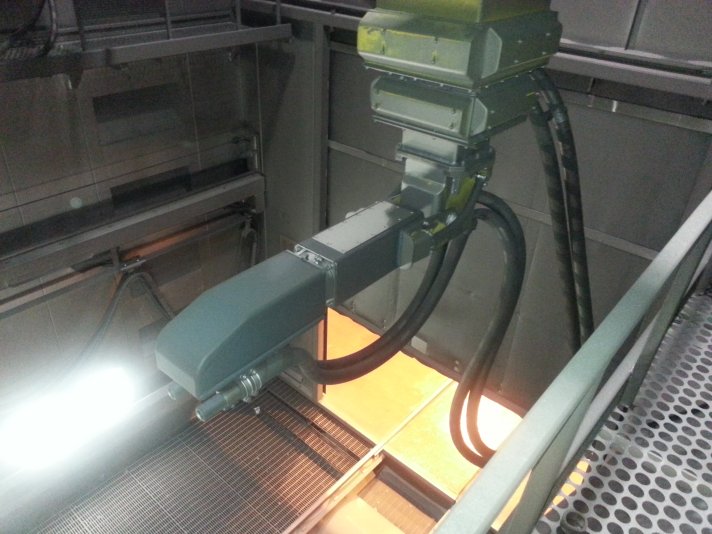
Blastman B20S blasting robot in railcar manufacturing
Tailored robotic blasting solutions for complex structures
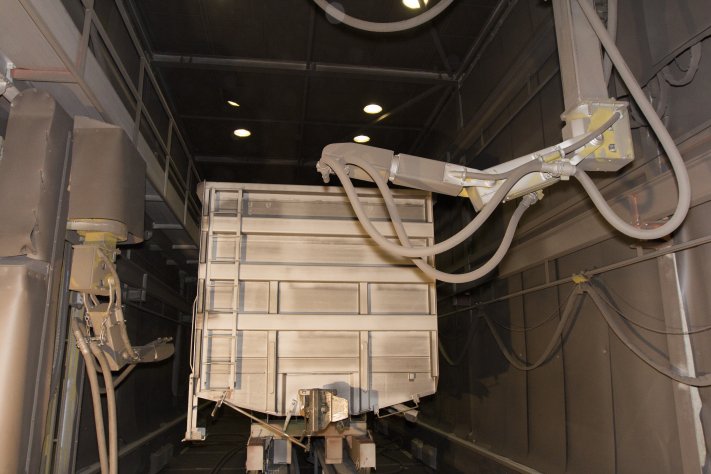
Railcar production presents specific challenges for automation. In one production line, robots are required to blast the interior of hopper cars through relatively small access openings.
To address this, Blastman developed a more compact solution of their existing gantry-type robot capable of entering confined spaces. A vision system was integrated to detect openings and adjust robot positioning in real time, ensuring smooth and accurate operation.
In another case, robots had to be installed in an existing blasting booth with strict space constraints, yet still be able to reach large workpieces. This required customized robot geometry and careful integration into the existing production environment.
These solutions highlight a key aspect of Blastman’s robotic blasting: standard technology alone is rarely enough—successful implementation depends on application-specific engineering.
Continuous upgrades support long-term performance
As production requirements evolved, the customer continued to modernize their robotic blasting systems. Earlier hydraulic robots were gradually replaced with servo-driven models, improving precision, reliability, and maintainability.
Upgrades were implemented in phases, allowing production to continue without disruption while steadily improving performance.
Today, the system reflects years of incremental development rather than a single transformation project.
Measurable benefits of robotic blasting
Robotic blasting now covers the vast majority of each workpiece, with programs created offline using simulation tools. This enables consistent coverage and efficient optimization before production execution.
In practical terms, robotic blasting has enabled:
- higher and more predictable production throughput
- consistent surface quality across varying conditions
- significantly reduced need for manual blasting
- improved working conditions in a demanding environment
Manual work is now primarily focused on finishing tasks, such as cleaning, rather than heavy blasting.
Reliable support ensures uptime
Long-term performance has been supported by close cooperation with Blastman’s service team. Over more than 20 years, support has remained responsive and solution-oriented, helping to resolve issues quickly and minimize downtime.
Despite geographical distance, access to support has remained reliable, which has been critical in maintaining continuous production.
Built for harsh blasting environments
Blasting is inherently a demanding process, exposing equipment to abrasive materials and extreme conditions. Despite this, the robotic systems have demonstrated strong durability and long service life. Minimal downtime and stable performance have allowed the customer to maintain high production rates year after year.
Looking ahead, further upgrades are already being planned to ensure continued uptime and efficiency as equipment ages.
What robotic blasting enables in heavy manufacturing
In heavy manufacturing environments such as railcar production, robotic blasting provides a scalable way to improve both productivity and safety.
It enables manufacturers to automate demanding surface treatment processes while maintaining consistent quality and reducing manual workload.
This case demonstrates how robotic blasting can evolve from an initial investment into a long-term capability—one that continues to deliver value through ongoing development, upgrades, and partnership.
“We’ve been using Blastman Robotics at our facility for over 20 years. Our original robots held up to near constant use for over 15 years in the extremely harsh blasting environment, and most recently, we have upgraded to the newer servo models. These robots have allowed us to continue our high production rates while maintaining quality and efficiency in our blasting process. Their support staff has been extremely helpful in troubleshooting any issues, allowing us to keep production downtime to a minimum. We would recommend Blastman robotics for anyone’s blasting needs.”
Blastman is participating in Innotrans in September in Berlin.

You might be interested in these articles
Blog Posts Company News Events
08. Sep 2026
ABRASIVE BLASTING INVALUABLE FOR RAIL INDUSTRY
Company News Events
19. Aug 2026
AUTOMATED BLASTING CHAMBER VS. SINGLE BLASTING ROBOT: A COMPLETE COMPARISON
Company News Events
01. Jul 2026
Meet Blastman at InnoTrans 2026
Company News Events
07. May 2026
BLAST CLEANING OF TRANSFORMERS
Company News Events
22. Apr 2026
ROBOTIC BLASTING IMPROVES THROUGHPUT, CONSISTENCY, AND SAFETY IN RAILCAR PRODUCTION
Blog Posts Company News Events
30. Mar 2026
BLAST CLEANING OF EXTERIOR SURFACE OF WIND TURBINE TOWERS
Blog Posts Company News
26. Mar 2026