
AUTOMATED BLASTING CHAMBER VS. SINGLE BLASTING ROBOT: A COMPLETE COMPARISON
AUTOMATED BLASTING CHAMBER VS. SINGLE BLASTING ROBOT: A COMPLETE COMPARISON
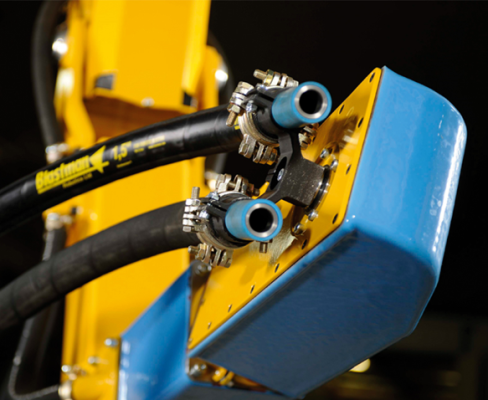
When investing in robotic abrasive blasting, one of the first decisions manufacturers face is whether to automate an existing blast room with a single blasting robot or invest in a fully automated blasting chamber. While both solutions improve productivity, consistency, and operator safety compared with manual blasting, they serve different production goals.
This comparison explains the key differences and helps identify which approach best supports your manufacturing requirements.
What is the difference between an automated blasting chamber and a single blasting robot?
The key difference lies in what is being automated.
A single blasting robot automates the blasting operation itself. It can often be integrated into an existing blast room, providing a practical way to improve process consistency while making use of existing infrastructure. Blastman's wall-mounted robots, for example, are designed for both new installations and retrofit projects.
An automated blasting chamber automates the entire blasting process. In addition to one or more blasting robots, it integrates supporting systems such as abrasive handling, recovery, dust collection, blast pots, controls and material handling into one coordinated solution. Rather than improving only one process step, the objective is to optimise the complete surface preparation process.
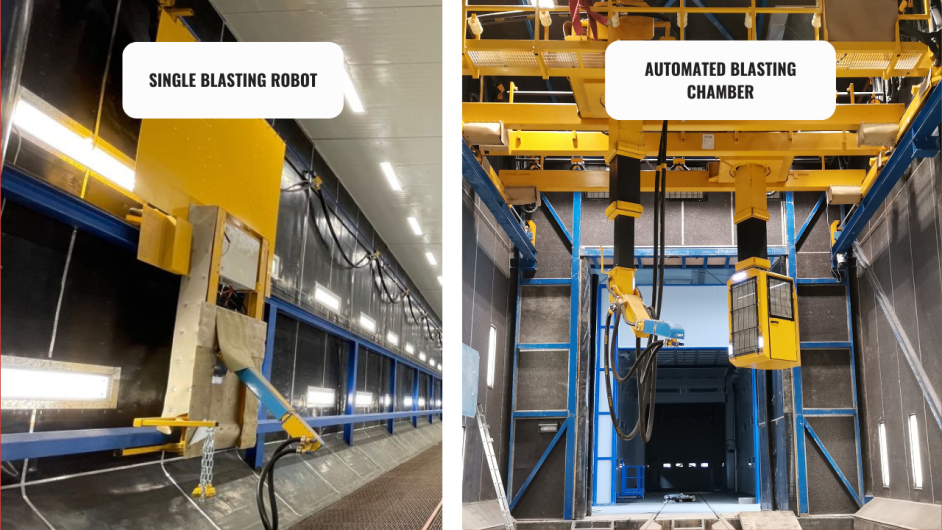
Automated blasting chamber vs. single blasting robot
Automated blasting chamber vs. single blasting robot at a glance
| Feature | Single blasting robot | Automated blasting chamber |
|---|---|---|
| Primary objective | Automate blasting | Optimize the complete blasting process |
| Typical installation | Existing blast room or retrofit | New installation or complete modernization |
| Initial investment | Lower | Higher |
| Process integration | Limited | High |
| Productivity potential | High | Very high |
| Scalability | Good |
Excellent |
Productivity and process efficiency
Both solutions increase productivity by replacing manual blasting with programmed robotic movements that deliver repeatable blasting patterns and more consistent surface quality.
The difference becomes clear when production extends beyond the robot itself.
A single blasting robot improves one stage of the process, while an automated blasting chamber optimises how blasting, abrasive circulation, recovery, ventilation and process control work together. Blastman's Robot Blastroom 4.0 concept is built around this integrated approach, using intelligent automation to improve productivity, process visibility and operational efficiency across the entire blasting chamber.
For manufacturers with growing production volumes or demanding throughput targets, optimising the whole process often delivers greater long-term value than automating nozzle movement alone.
Which solution is right for your production?
A single blasting robot is often the better choice when you want to:
- Modernise an existing blast room
- Introduce automation in phases
- Improve consistency with a lower initial investment
- Preserve existing infrastructure where appropriate
An automated blasting chamber is typically the better option when your priorities include:
- Maximising throughput
- Standardising quality across production
- Integrating blasting into an automated production line
- Building a scalable solution for future growth
Rather than asking which solution is better, manufacturers should consider which level of automation best supports their production strategy.
Looking beyond the initial investment
Initial purchase cost is only one part of the investment decision.
A single blasting robot generally requires less capital because much of the existing installation can remain in use. An automated blasting chamber requires a larger investment, but can improve overall operational performance by integrating systems that influence productivity, process stability and equipment utilisation.
Blastman's customer projects illustrate this difference. In one installation for AMADA, the solution combined multiple robots, intelligent programming, blast pots and supporting chamber systems into a fully integrated automated blasting process designed to increase productivity and ensure consistent quality.
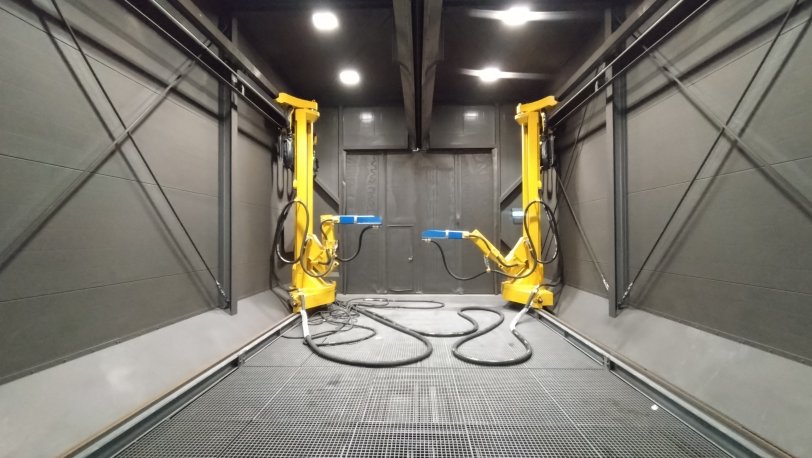
Blastman complete delivery
Frequently asked questions
Can a blasting robot be installed in an existing blast room?
Yes. Robotic blasting solutions can be integrated into existing blast rooms, allowing manufacturers to automate blasting without replacing the complete installation.
Is an automated blasting chamber always the better investment?
No. The right solution depends on production volume, existing infrastructure, automation objectives and long-term business goals.
Does robotic blasting improve surface preparation quality?
Yes. Robotic blasting delivers repeatable blasting patterns and more consistent process control than manual blasting, helping manufacturers achieve more uniform surface preparation.
Finding the right level of blasting automation
Both single blasting robots and automated blasting chambers represent a significant step forward from manual blasting. The difference is not simply the number of robots, but the level of process integration.
If the objective is to modernise an existing blast room, a single blasting robot may provide the most practical path to automation. If the goal is to optimise the entire surface preparation process, maximise productivity and build a future-ready production environment, an automated blasting chamber offers a more comprehensive solution.
You might be interested in these articles
Blog Posts Company News
19. Oct 2026
BUILT TO BLAST - HOW TO MAKE ROBOTS LAST FOR DECADES
Blog Posts Company News Events
08. Sep 2026
ABRASIVE BLASTING INVALUABLE FOR RAIL INDUSTRY
Company News Events
19. Aug 2026
AUTOMATED BLASTING CHAMBER VS. SINGLE BLASTING ROBOT: A COMPLETE COMPARISON
Company News Events
01. Jul 2026
Meet Blastman at InnoTrans 2026
Company News Events
07. May 2026
BLAST CLEANING OF TRANSFORMERS
Company News Events
22. Apr 2026
ROBOTIC BLASTING IMPROVES THROUGHPUT, CONSISTENCY, AND SAFETY IN RAILCAR PRODUCTION
Blog Posts Company News Events
30. Mar 2026